
3D Printing
Choosing the Right 3D Printing Material
Choosing the appropriate material for your 3D printing project is crucial to achieving the desired outcome in terms of strength, appearance, functionality, and more. At Daksh Technologies we offer a variety of materials, each with its own unique properties. This guide will help you understand the options available and make an informed decision based on your project’s requirements.
1. PLA (Polylactic Acid)
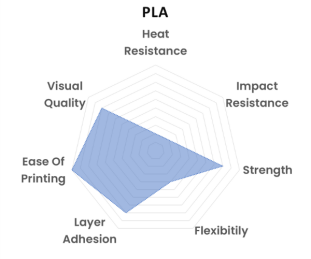
Properties: PLA is a biodegradable and environmentally friendly material derived from renewable resources such as cornstarch or sugarcane. It is easy to print with, produces minimal odors, and comes in a wide range of colors.
Best For: PLA is great for producing prototypes, decorative objects, and low-stress applications. It’s not suitable for high-temperature or mechanically demanding applications.
2. ABS (Acrylonitrile Butadiene Styrene)
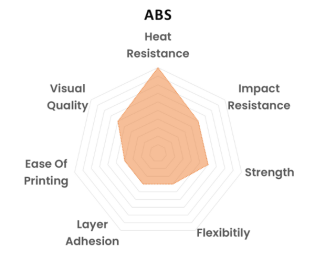
Properties: ABS is a strong and durable thermoplastic material. It has good impact resistance and can withstand moderate temperatures. It may emit slight fumes during printing.
Best For: ABS is suitable for functional prototypes, mechanical parts, and objects that require impact resistance. It’s less suitable for applications that require food contact due to potential chemical leaching.
3. PETG (Polyethylene Terephthalate Glycol)
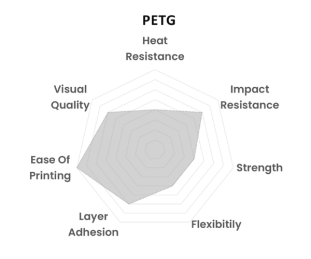
Properties: PETG is known for its toughness, chemical resistance, and transparency. It has similar properties to both PLA and ABS, making it a versatile choice.
Best For: PETG is a good choice for objects that require durability, clarity, and chemical resistance. It’s suitable for both functional prototypes and artistic creations.
4. TPU (Thermoplastic Polyurethane)
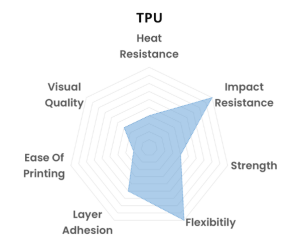
Properties: TPU is a flexible and elastic material with excellent impact absorption. It can be printed with varying levels of flexibility.
Best For: TPU is ideal for producing flexible parts, gaskets, seals, and objects that require shock absorption. It’s commonly used in footwear, wearables, and mechanical components.
5. ASA (Acrylonitrile Styrene Acrylate)
Properties: ASA is known for its excellent weather resistance, UV stability, and strength. It has similar properties to ABS but with enhanced outdoor durability and resistance to fading.
Best For: ASA is suitable for outdoor applications, functional prototypes, and parts exposed to harsh environments. It’s an ideal choice when durability and weather resistance are essential.
7. Nylon (PA)
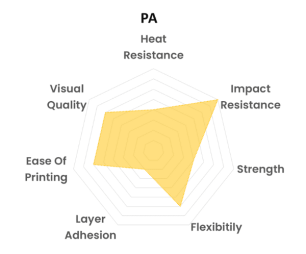
Properties: Nylon is a strong and versatile material known for its excellent tensile strength, durability, and flexibility. It has good chemical resistance and can withstand mechanical stress.
Best For: Nylon is suitable for producing functional prototypes, mechanical parts, and objects requiring toughness and flexibility. It’s used in a wide range of industries, including robotics, medical, and consumer goods.
8. Carbon Fiber Reinforced Filaments (PACF, PCCF)
Properties: Nylon is a strong and versatile material known for its excellent tensile strength, durability, and flexibility. It has good chemical resistance and can withstand mechanical stress.
Best For: Nylon is suitable for producing functional prototypes, mechanical parts, and objects requiring toughness and flexibility. It’s used in a wide range of industries, including robotics, medical, and consumer goods.
6. PC (Polycarbonate)
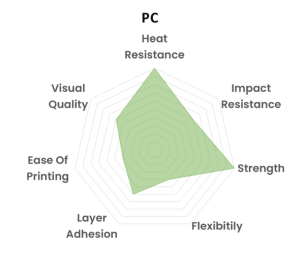
Properties: Carbon fiber filaments combine the strength and stiffness of carbon fiber with the ease of 3D printing. They offer improved structural integrity and dimensional stability.
Best For: Carbon fiber reinforced filaments are ideal for applications requiring high strength-to-weight ratios, such as lightweight structural components, drones, and automotive parts.
Remember, each material has its own strengths and limitations. It’s essential to consider factors such as mechanical properties, temperature resistance, appearance, and intended use when selecting a material for your 3D printing project. If you’re uncertain about the best material for your needs, feel free to contact our experts at info@daskhtechnologies.com.au . We’re here to help you make the right choice for your project’s success.